
by Russell Noga | Updated October 16th, 2026
Medicare Supplement plans, also called Medigap, pay the deductibles, coinsurance and copays Original Medicare leaves behind. For 2027 the 10 standardized plans keep the same benefits, but several key dollar amounts change, and thousands of people losing Medicare Advantage plans are shopping for Medigap for the first time.
Below we cover what every plan pays, the new 2027 numbers, how Plan G and Plan N compare, what drives your premium, and when you can enroll without health questions.
Key Takeaway
Every company’s Plan G has the same benefits, so the smartest 2027 move is to pick the plan letter that fits how you use care, then compare companies on price. Plan G remains the most complete plan for new enrollees, and Plan N is the strongest lower-premium choice.
New for 2027
See the 2027 copays, the Part B deductible and Plan N vs Plan G in our guide to Medicare Supplement Plan N 2027.
Medicare Supplement plans 2027 at a glance
What Changes for Medicare Supplement Plans in 2027
Federal law sets the benefits in each plan letter, so a 2027 Plan G covers the same things a 2026 Plan G did. What changes each year are the Medicare amounts those plans work around:
| Medicare Cost | 2026 | 2027 |
|---|---|---|
| Part B deductible (what Plan G and N leave you) | $283 | About $292 projected; final amount announced in November |
| High-deductible Plan G and F deductible | $2,950 | $3,050 |
| Part B standard premium | $202.90 a month | About $209.50 projected; final amount announced in November |
| Part A hospital deductible (covered by most plans) | $1,736 | Announced in November |
| Part D drug deductible (separate drug plan) | Up to $615 | Up to $700 |
| Part D out-of-pocket cap | $2,100 | $2,400 |
Sources: CMS 2027 Medigap high-deductible announcement, CMS 2027 Part D parameters and 2026 Medicare Trustees Report projections. We update this table when CMS releases the final 2027 Part A and Part B amounts.
Good to know: Several large insurers, including Humana, UnitedHealthcare and Aetna, are pulling Medicare Advantage plans from counties for 2027. If your Medicare Advantage plan is ending, you may have a one-time right to buy a Medicare Supplement plan with no health questions. See the guaranteed issue section below.
All 10 Medicare Supplement Plans Compared
Here is what each plan letter leaves you to pay in 2027. Every plan covers Part A hospital coinsurance, 365 extra hospital days, Part B coinsurance (fully or partly), hospice coinsurance and the first three pints of blood.
| Plan | Who Can Buy It | What You Still Pay |
|---|---|---|
| Plan G | Anyone with Medicare A and B | Only the Part B deductible |
| High-Deductible Plan G | Anyone with Medicare A and B | Medicare-covered costs up to $3,050 in 2027, then nothing |
| Plan N | Anyone with Medicare A and B | Part B deductible, copays up to $20 for some office visits and up to $50 for some ER visits, excess charges |
| Plan F | Only if eligible for Medicare before 2020 | Nothing; high-deductible F has the same $3,050 deductible |
| Plan C | Only if eligible for Medicare before 2020 | Part B excess charges |
| Plan D | Anyone with Medicare A and B | Part B deductible and excess charges |
| Plan M | Anyone with Medicare A and B | Half the Part A deductible, Part B deductible and excess charges |
| Plan K | Anyone with Medicare A and B | 50% of most costs up to a yearly out-of-pocket limit, plus the Part B deductible |
| Plan L | Anyone with Medicare A and B | 25% of most costs up to a yearly out-of-pocket limit, plus the Part B deductible |
| Plan B | Anyone with Medicare A and B | Part B deductible, skilled nursing coinsurance, excess charges and foreign travel care |
| Plan A | Anyone with Medicare A and B | Part A and B deductibles, skilled nursing coinsurance, excess charges and foreign travel care |
Not every company sells every plan in every state. Massachusetts, Minnesota and Wisconsin use their own standardized plans.
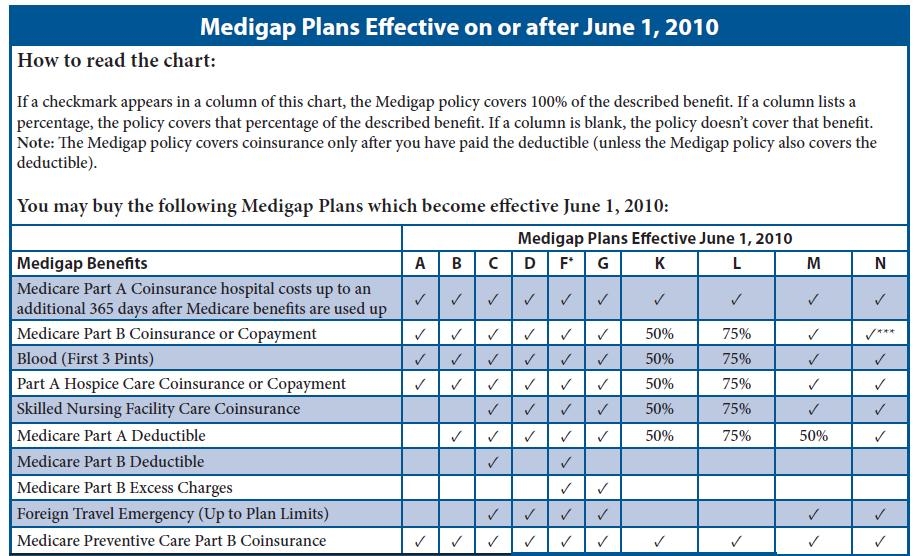
For the full benefit-by-benefit grid, see our Medicare Supplement plans comparison chart for 2027.
The 3 Most Popular Plans for 2027
Plan G
The most complete plan for new enrollees. After the Part B deductible, it pays 100% of Medicare-approved costs.
Plan N
A lower premium in exchange for small office and ER copays and no excess charge coverage.
High-Deductible Plan G
The lowest premium of the three, with a $3,050 deductible in 2027 before coverage starts.
Medicare Supplement Plan G 2027
Medicare Supplement Plan G is the top seller for people new to Medicare. Once you pay the Part B deductible, Plan G covers 100% of your Medicare-approved costs for the rest of the year, including Part B excess charges.

Medicare Supplement Plan N 2027
Medicare Supplement Plan N covers most of what Plan G does for a lower premium. You pay copays of up to $20 for some office visits and up to $50 for ER visits that do not end in admission, and Plan N does not cover Part B excess charges.

Plan G vs Plan N for 2027
Most 2027 shoppers end up choosing between these two plans. The difference comes down to copays, excess charges and the premium gap in your ZIP code.

Plan G fits if you
Plan N fits if you
Is Plan F Still Available in 2027?
Only for people who were eligible for Medicare before January 1, 2020. Federal law closed Plan F and Plan C to everyone who became eligible on or after that date, because both plans cover the Part B deductible.
Already on Plan F? Plan G covers everything Plan F does except the Part B deductible, and Plan F premiums often rise faster because no new members are joining. If your yearly savings on Plan G beat the deductible, switching can pay off, as long as you can pass health questions or have a right to switch.
What Drives Your Medicare Supplement Premium in 2027
Because the benefits are identical, price is where companies compete. These factors set your premium:
ZIP code
tobacco use
discounts
method
Popular companies include Mutual of Omaha, Aetna, Blue Cross Blue Shield, Allstate and Physicians Mutual. The same plan letter can cost very different amounts between them, so compare several before you choose. For more background, see our full Medicare Supplement plans guide.
When to Enroll in a Medicare Supplement Plan for 2027
The best time to buy is your 6-month Medigap Open Enrollment Period. It starts the first day of the month you are both 65 or older and enrolled in Part B. During those six months, companies must accept you and cannot charge more because of your health.
Good to know: The October 15 to December 7 Annual Enrollment Period is for Medicare Advantage and Part D. It does not give you a right to change Medicare Supplement plans without health questions. Some states add protections, such as year-round guaranteed issue in New York and Connecticut, and birthday or anniversary rules in states like California and Oregon.
Losing Your Medicare Advantage Plan in 2027?
If your Medicare Advantage plan is leaving Medicare or your area, federal law generally gives you a guaranteed issue right to buy certain Medicare Supplement plans with no health questions, which for most people includes Plan G.
How to Choose a Medicare Supplement Plan for 2027

The Bottom Line
Medicare Supplement plans keep the same benefits in 2027, but the high-deductible Plan G deductible rises to $3,050 and other Medicare costs are moving up. Plan G remains the most complete choice, Plan N saves on premiums, and comparing companies is where the real savings are. Compare 2027 rates on this page or call 1-888-891-0229.
Frequently Asked Questions
➤ What are Medicare Supplement plans?
Medicare Supplement plans, also called Medigap, are policies sold by private insurance companies that pay some or all of the costs Original Medicare leaves behind, such as deductibles, coinsurance and copays. There are 10 standardized plans, labeled A through N, and each plan letter has the same benefits no matter which company sells it.
➤ What is the best Medicare Supplement plan for 2027?
For most people new to Medicare, Plan G is the best overall choice because it covers everything except the Part B deductible. Plan N is a strong lower-premium option for healthy people, and high-deductible Plan G suits people who want the lowest premium and can cover a $3,050 deductible.
➤ How much do Medicare Supplement plans cost in 2027?
Premiums depend on your plan letter, age, ZIP code, gender, tobacco use and the company’s pricing method. The same Plan G can cost very different amounts from one company to the next in the same ZIP code, so comparing companies is the best way to save.
➤ What changes for Medicare Supplement plans in 2027?
The benefits in each plan letter stay the same, but the dollar amounts they work around change. The high-deductible Plan G and F deductible rises to $3,050, and the Part B deductible is projected at about $292, with the final amount announced in November.
➤ Is Plan F still available in 2027?
Only for people who were eligible for Medicare before January 1, 2020. Anyone who became eligible on or after that date cannot buy Plan F or Plan C, and Plan G is the closest replacement.
➤ When can I enroll in a Medicare Supplement plan?
You can apply any time of year. The best time is your 6-month Medigap Open Enrollment Period, which starts the month you are 65 or older and enrolled in Part B, because companies cannot turn you down or charge more for your health during that window.
➤ Can I change Medicare Supplement plans during Annual Enrollment?
The October 15 to December 7 Annual Enrollment Period is for Medicare Advantage and Part D, not Medigap. You can apply to change Medicare Supplement plans any time, but in most states you will answer health questions unless you have a guaranteed issue right or a state rule that protects you.
➤ Do Medicare Supplement plans cover prescription drugs?
No. Medicare Supplement plans sold today do not include drug coverage, so you need a separate Medicare Part D plan. For 2027, the Part D deductible can be up to $700 and out-of-pocket drug costs are capped at $2,400.
➤ Can I switch from Medicare Advantage to a Medicare Supplement plan in 2027?
Yes. If your Medicare Advantage plan is leaving your area, you generally have a guaranteed issue right to buy certain Medigap plans with no health questions, including Plan G for most people. If you are switching by choice, you can drop Medicare Advantage during Annual Enrollment, but you may need to answer health questions to get a Medigap plan.
➤ How do I compare Medicare Supplement rates?
Enter your ZIP code in the quote tool on this page to compare 2027 rates from top companies in your area. You can also call 1-888-891-0229 and a licensed agent will compare plans and help with the application at no cost.
New for 2027
See the 2027 deductibles, what drives 2027 premiums and high-deductible Plan G in our guide to Medicare Supplement Plan G 2027.

Russell Noga is the CEO and Medicare editor of Medisupps.com. His 15 years of experience in the Medicare insurance market includes being a licensed Medicare insurance broker in all 50 states. He is frequently featured as a featured as a keynote Medicare event speaker, has authored hundreds of Medicare content pages, and hosts the very popular Medisupps.com Medicare Youtube channel. His expertise includes Medicare, Medigap insurance, Medicare Advantage plans, and Medicare Part D.