
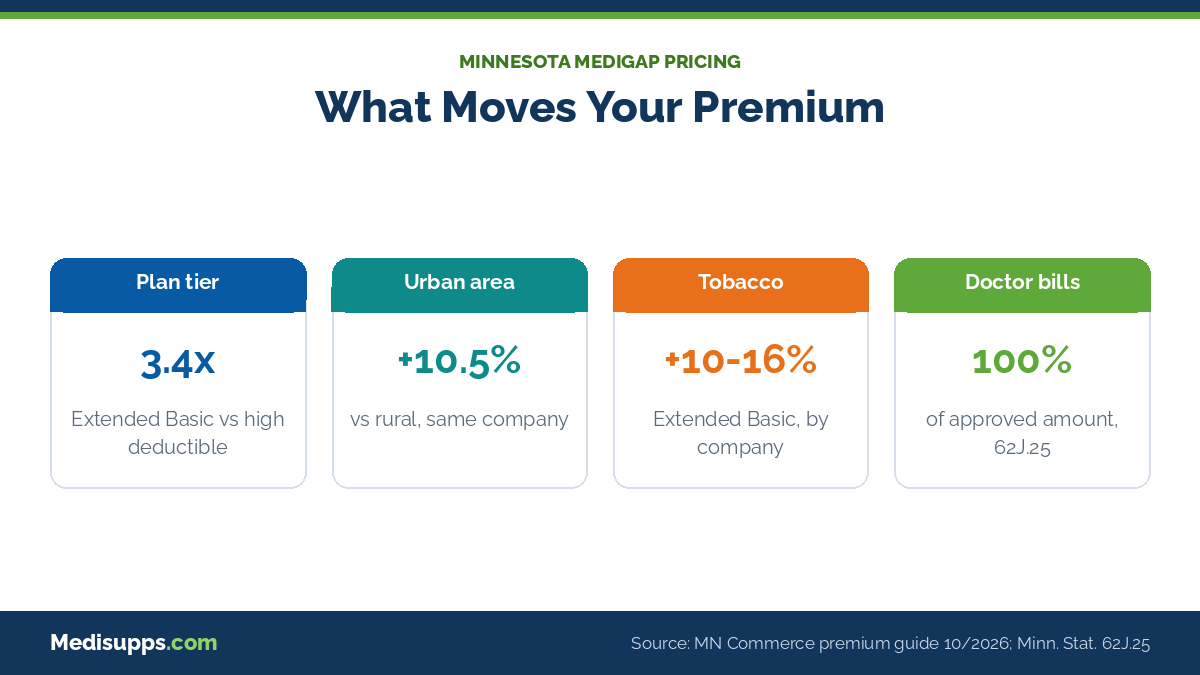
Medicare Supplement plans in Minnesota are priced on four things you can see before you buy: the plan tier you choose, the rating area you live in, whether you use tobacco, and the company. In the state’s October 2026 premium guide, those choices move the yearly cost of coverage from under $700 to more than $6,400.
Minnesota Medigap prices
See Minnesota Medigap Prices for Your County
Compare Extended Basic, copay and cost-sharing plans from several companies.
Rates and plan availability vary by state, age and insurance company.
This page is about price, not plan design. It uses the Minnesota Department of Commerce Annual Premium Guide, updated October 1, 2026, to show how much each factor is worth in dollars, and it explains a 1990s Minnesota law that quietly limits what most providers can bill you. For how Minnesota’s Basic and Extended Basic plans are built, and the state’s new yearly enrollment window, start with our main Minnesota Medicare Supplement guide.
One caution first. Minnesota is one of three states that use their own Medigap designs, so you will not see a lettered Plan G on a Minnesota quote. If you are comparing with other states, our overview of Medicare Supplement plans for 2027 shows the federal letters.
Bottom line first
Your Minnesota Medigap premium depends mostly on the plan tier, then the company, then tobacco use and rating area. In the October 2026 state guide, tobacco users paid roughly 10% to 16% more and urban rates ran about 10% above rural rates at the same company.
Four Factors Behind Every Minnesota Medigap Quote
The Commerce guide lists yearly premiums for 12 companies. Read across a single company’s row and the same four factors keep showing up. Read down the columns and you see how far apart companies are for identical benefits.
There is a fifth factor this year: the surcharge on policies bought through Minnesota’s new annual enrollment window for ages 65 to 70. The guide notes that an additional rating factor applies during that window. If you are enrolling in your first six months on Part B, it does not apply to you.
The Price Ladder: Five Plan Tiers at One Company
One company in the guide files every Minnesota tier, which makes a clean ladder. These are its non-tobacco yearly rates. The lower you go, the more of your medical bills you share.
| Plan tier | Yearly premium | About per month | What you take on |
|---|---|---|---|
| Extended Basic | $3,518 | $293 | Little beyond the $292 Part B deductible in 2027 |
| $20/$50 copay plan | $1,981 | $165 | Office and ER copays, plus the deductible |
| 75% cost-sharing plan | $1,877 | $156 | 25% of many costs up to a yearly cap |
| 50% cost-sharing plan | $1,092 | $91 | 50% of many costs up to a higher yearly cap |
| High-deductible plan | $1,022 | $85 | All costs up to a large deductible, then little |
Source: Minnesota Department of Commerce Annual Premium Guide, updated 10/01/2026, one company’s non-tobacco annual rates. Monthly figures are our math, rounded. Out-of-pocket caps and the high deductible are set each year.
The step from Extended Basic to the copay plan saves $1,537 a year. The step from the copay plan down to the 50% plan saves another $889, but it changes the deal: instead of a flat $20 copay, you pay half of a hospital stay’s Part A deductible and half of many other bills until you reach the plan’s annual limit. That trade works best for people who can cover a few thousand dollars in a bad year.
Price the cap, not just the premium
For the 50% and 75% plans, add the yearly premium to the plan’s out-of-pocket limit for 2027. That sum is your worst-case year, and it is the fair number to compare with Extended Basic.
Rural Versus Urban: What Your ZIP Code Adds
Four companies in the guide price by rating area. The gap is consistent: at the two companies below, urban Extended Basic costs about 10.5% more than rural.
| Non-tobacco, yearly | Rural | Urban | Urban extra |
|---|---|---|---|
| Company 1, Extended Basic | $4,354 | $4,812 | $458 |
| Company 1, $20/$50 copay plan | $2,681 | $2,963 | $282 |
| Company 2, Extended Basic | $4,147 | $4,583 | $436 |
| Company 2, $20/$50 copay plan | $2,810 | $3,106 | $296 |
Source: Minnesota Department of Commerce Annual Premium Guide, updated 10/01/2026. Companies are shown by number because each defines its own rating areas. Last column is our math.
Each company decides which counties count as urban, so a county can be urban at one company and rural at another. Always ask which area your quote uses. A company that prices statewide may beat an urban-rated company for a metro address and lose to it for a rural one. Twin Cities readers can see local notes on our Minneapolis Medicare Supplement plans page.

Before you compare quotes
Minnesota premiums depend on a rating area each company defines for itself. Two quotes for the same plan are comparable only when both use the same tobacco status and the correct area for the home address, so confirm both items on every quote.
Russell Noga, Licensed Insurance Agent
How Much Tobacco Use Adds in Minnesota
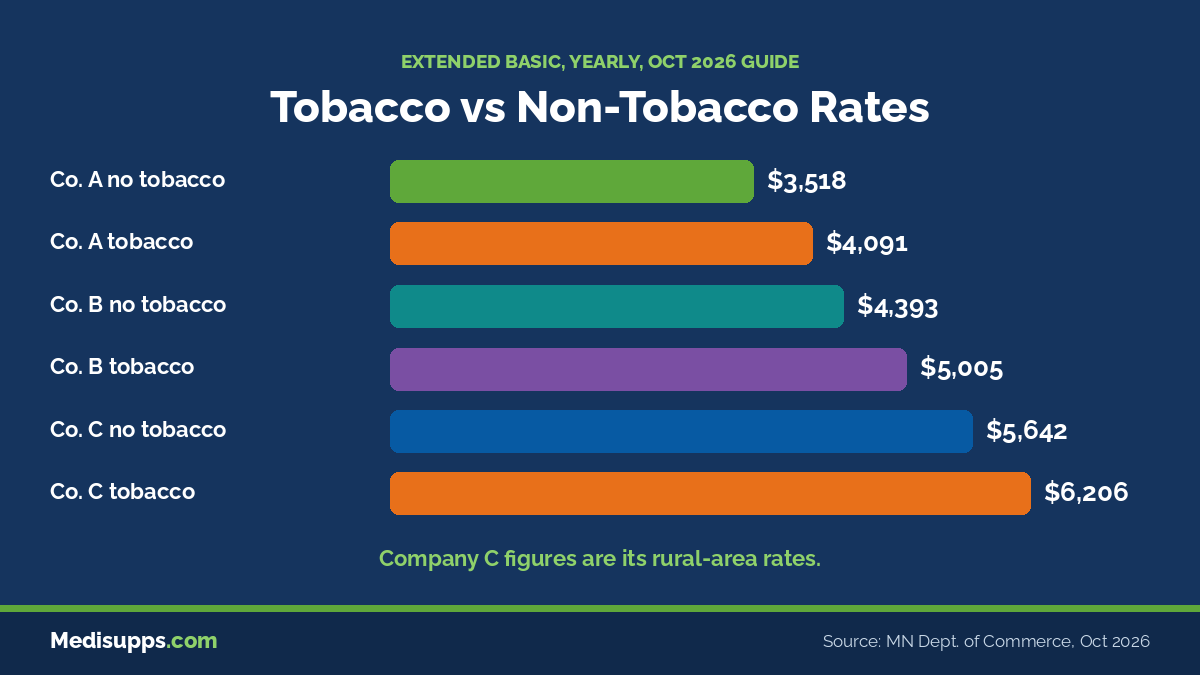
Every company in the October 2026 guide lists a tobacco rate next to its non-tobacco rate. For Extended Basic, the extra charge ran from roughly 10% to about 16% depending on the company.
Key takeaway
Across the three companies shown, tobacco use added roughly $560 to $610 a year to Extended Basic. Over ten years of coverage, that is more than $5,500 before any rate increases.
Applications ask about tobacco use, and the answer sets your rate class. Some companies let a policyholder ask for the non-tobacco rate after quitting for a set period, but the rules differ by company and are not in the state guide, so ask before you buy rather than assuming the higher rate is permanent.
Minnesota’s Limit on Doctor Bills and the Excess Charge Rider
In most states, a doctor who does not accept Medicare assignment can bill up to 15% above Medicare’s approved amount. These Part B excess charges are the main reason buyers elsewhere pay extra for Plan G over Plan N.
Minnesota closed most of that gap in the 1990s. Minnesota Statutes 62J.25, titled Mandatory Medicare Assignment, phased the limit down from 115% of the approved amount in 1993 to 100% starting January 1, 1996. Since then, a health care provider may not charge a Minnesota resident on Medicare more than the approved amount for a Medicare-covered service. Deductibles and coinsurance are still owed.
Two exceptions
The law does not apply to ambulance services or to medical supplies and equipment. A supplier that does not accept assignment must tell you before the sale that it charges more than the approved amount.
That is why the 100% Part B excess rider in the Commerce guide is cheap, from $0 to about $103 a year at non-tobacco rates. It still has a job: care received in another state, ambulance rides and medical equipment can produce bills above the approved amount. For Minnesotans who winter elsewhere, the rider is inexpensive protection.
Minnesota Medigap Quotes
Call a Licensed Agent Now
Licensed agents compare Minnesota Medicare Supplement rates from several companies at no cost.
No obligation to enroll
Choosing a Minnesota Plan Tier for 2027
If you are weighing Extended Basic against the federal plan you may have had elsewhere, our page on Medicare Plan G in Minnesota lines them up benefit by benefit. You can also browse all Medicare Supplement plans or start at the Medisupps.com home page.
Free comparison
Find the Right Minnesota Plan Tier for Your Budget
Rates differ by company, area and tobacco use. Compare them side by side.
Rates and plan availability vary by state, age and insurance company.
Minnesota Medigap Pricing: Common Questions
➤ Do rural Minnesotans pay less for Medigap?
Often, at companies that price by area. In the October 2026 Commerce guide, urban Extended Basic ran about 10.5% above rural at two companies. Companies that use one statewide rate do not make that distinction.
➤ How much more do tobacco users pay for a Minnesota Medicare Supplement plan?
In the state guide, tobacco rates for Extended Basic were about 10% to 16% higher than non-tobacco rates, or roughly $560 to $610 a year at the companies shown in the guide.
➤ Can a Minnesota doctor charge more than Medicare’s approved amount?
Generally no. Minnesota Statutes 62J.25 has limited providers to the Medicare-approved amount for covered services since 1996. Ambulance services and medical supplies and equipment are exceptions.
➤ Do I need the Part B excess rider in Minnesota?
It matters less than in other states because of the state’s billing limit, but it can still help with ambulance bills, medical equipment and care outside Minnesota. It costs little, from $0 to about $103 a year in the guide.
➤ What is the cheapest Medicare Supplement plan in Minnesota?
The high-deductible and 50% cost-sharing plans have the lowest premiums, about $1,000 to $1,100 a year at one company in the October 2026 guide, but you pay much more when you need care.
➤ Can I buy Medigap in Minnesota if I am under 65?
Yes. The NAIC’s May 2026 state chart lists Minnesota as a state where Medigap is available to people under 65 on Medicare. Prices and plan choices may differ from the 65-and-older rates.
Free Minnesota Rate Check
Call a Licensed Agent Now
Compare Medicare Supplement rates from several insurance companies in one call.
No obligation to enroll
Medisupps.com is operated by ZRN Health & Financial Services, LLC, a licensed insurance agency based in Austin, Texas. We are not connected with or endorsed by the U.S. government or the federal Medicare program. Premiums are examples only; your rate depends on your age, ZIP code, tobacco use and the insurance company.

Russell Noga is the CEO and Medicare editor of Medisupps.com. His 15 years of experience in the Medicare insurance market includes being a licensed Medicare insurance broker in all 50 states. He is frequently featured as a featured as a keynote Medicare event speaker, has authored hundreds of Medicare content pages, and hosts the very popular Medisupps.com Medicare Youtube channel. His expertise includes Medicare, Medigap insurance, Medicare Advantage plans, and Medicare Part D.