
 Reviewed by: Russell Noga, Licensed Insurance Agent · Updated November 23, 2026
A Farm Bureau Medicare Supplement can mean two different things in 2027: a member-only Medigap policy insured by a Farm Bureau-affiliated health insurer, as in Tennessee, or a policy from an unrelated insurer such as Anthem or Humana that a Farm Bureau agent sells, as in Virginia. The benefits are federally standardized either way, but who insures you, who sets your rate and whether dues matter are not.
Compare before you join
Price a Farm Bureau Medigap Plan Against Other Insurers
See the same plan letter from several companies in your county.
Rates and plan availability vary by state, age and insurance company.
Knowing which version you are being offered is the first step. This guide explains both models, the uncommon Plan D that Tennessee’s program sells, and how the 2027 Medicare figures change your costs. For a state-by-state review of where Farm Bureau Medigap programs exist, see our main Farm Bureau Medicare Supplement review.
Quick answer
If the policy names a Farm Bureau-affiliated insurer and requires dues, it is a member program; if it names a national insurer, Farm Bureau is acting as the agency. Compare either one with open-market quotes for the same plan letter.
Two Kinds of Farm Bureau Medigap
State Farm Bureau federations are independent of one another, and each decides how to help members with Medicare. Public records show two models.
| Member program (insured) | Farm Bureau as the agency | |
|---|---|---|
| Example | Tennessee: Farm Bureau Health Plans, insured by TRH Health Insurance Company | Virginia Farm Bureau, quoting Anthem, Humana, Sentara and UnitedHealthcare |
| Who pays claims | The affiliated health insurer | The national or regional insurer named on the policy |
| Membership dues | Required to keep the policy in Tennessee | Rates come from the insurer, not membership |
| Plans | A, D, G and N marketed in Tennessee | Whatever each represented insurer files in the state |
Sources: Farm Bureau Health Plans (Tennessee) Plan G page; Virginia Farm Bureau health insurance page.
Virginia Farm Bureau says it represents four organizations with more than 35 plan products and does not offer every plan sold in the state. Farm Bureau Financial Services, which operates in several Midwest and Western states, describes its Medicare Supplement, Medicare Advantage and drug plans as underwritten by insurers not affiliated with its companies, and Iowa Farm Bureau says its local agents can offer a variety of Medigap and Medicare Advantage plans.
How to Tell Which Version You Are Buying
Why it matters
With an agency sale, Farm Bureau membership does not change the insurer’s price. With a member program, the dues are part of the real cost and a lapse can affect your coverage or rate, so add a full year of dues to the premium before comparing.
Dues and the real price
When Farm Bureau membership is a condition of a Medigap policy, the yearly cost is the premium plus the dues. A policy that looks $5 a month cheaper can cost more once a full year of membership dues is added.
Russell Noga, Licensed Insurance Agent
Plan D: The Uncommon Plan in Tennessee’s Lineup
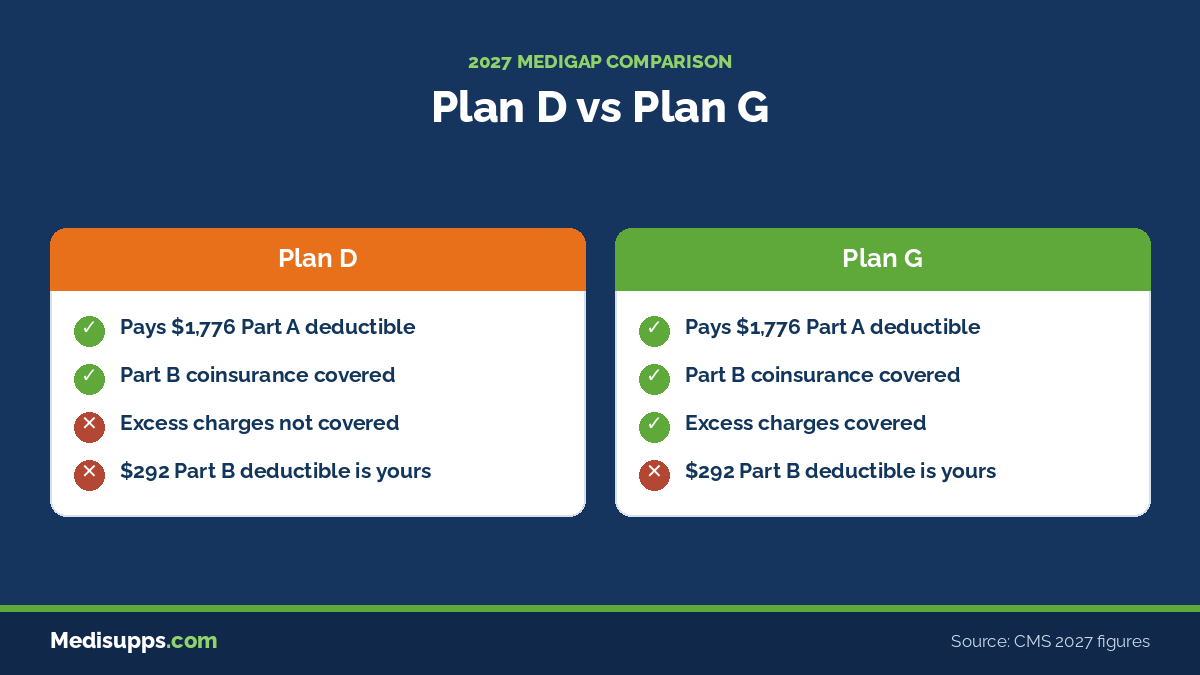
Most insurers focus on Plans G and N, but Farm Bureau Health Plans in Tennessee also markets Plan D. Plan D and Plan G pay the same core benefits: the Part A deductible, hospital and skilled nursing coinsurance, Part B coinsurance and foreign travel emergencies. Neither pays the Part B deductible. The one difference is Part B excess charges, which Plan G pays and Plan D does not.
2027 Math: Plan D vs Plan G
A doctor who does not accept Medicare assignment can charge up to 15% more than Medicare’s approved amount. That limit is the most an excess charge can be, and it is what you weigh against Plan D’s premium savings.
| 2027 example | Plan D | Plan G |
|---|---|---|
| Part B deductible | $292, you pay | $292, you pay |
| $4,000 of approved Part B care from a non-assigning surgeon | Up to about $600 in excess charges | $0 |
| Part A hospital deductible ($1,776) | Plan pays | Plan pays |
| Break-even | Plan D wins if its yearly savings exceed the excess charges you actually face | Plan G wins after one large non-assigned bill |
Our illustration using the 2027 CMS Part B deductible and Medicare’s 15% limiting charge. Actual excess charges depend on the provider.
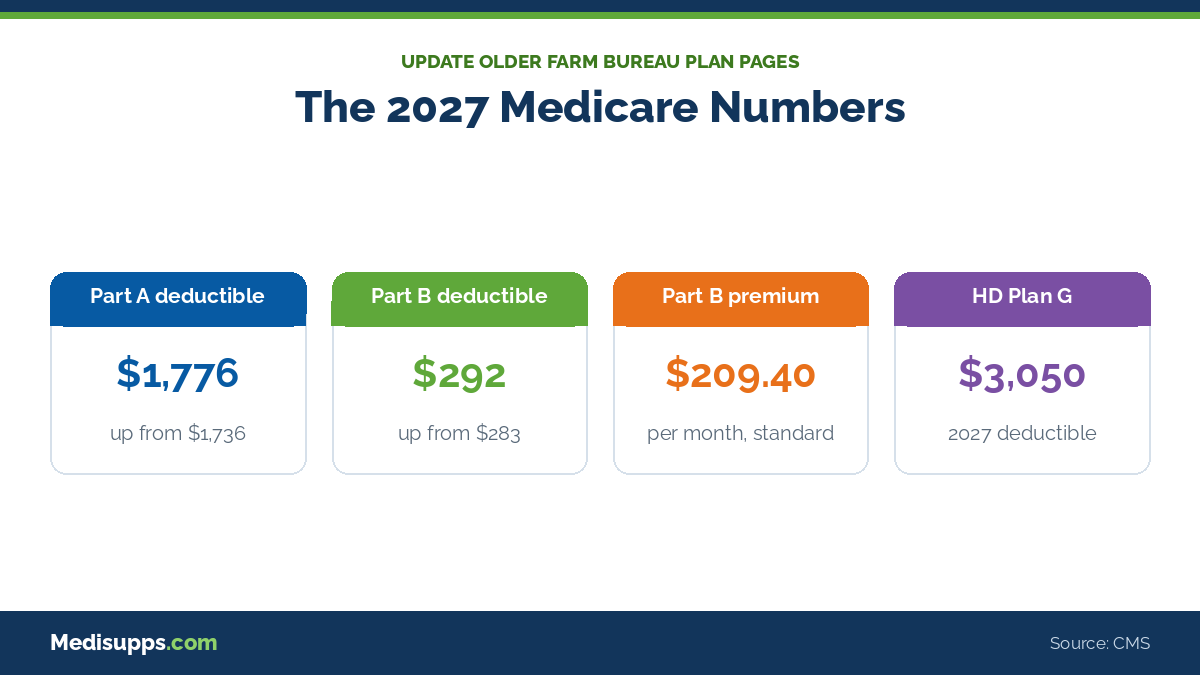
Tennessee’s Farm Bureau Plan G page still lists 2026 Medicare amounts, a $1,736 Part A deductible and a $283 Part B deductible. For 2027 those become $1,776 and $292, so update any comparison you make from older plan pages.
Medigap Quotes for Farm Families
Call a Licensed Agent Now
Licensed agents compare Farm Bureau-related and open-market Medicare Supplement rates at no cost.
No obligation to enroll
Where to Buy a Farm Bureau Plan
Whichever route you take, buy during your six-month Medigap open enrollment period if you can. It begins the month you are 65 or older and enrolled in Part B, and during it no insurer can decline you or raise your price for health reasons.
Is a Farm Bureau Medigap Plan Worth It?
- ✔The member premium plus a year of dues beats open-market quotes for the same plan letter.
- ✔You value local, in-person service at a county office.
- ✔The plan you want, such as Plan D, is not offered by competitors in your area.
- ✔You already belong to Farm Bureau for other reasons, so dues are not an added cost.
If none of those apply, an agency quote or an open-market policy may be simpler. Read more on Farm Bureau Plan G, compare other Medicare Supplement plans and the Medicare Supplement plans for 2027 overview, or begin at the Medisupps.com home page.
Free comparison
Plan D, G or N? See Which Costs Less Where You Live
Line up 2027 premiums before you pay a year of dues.
Rates and plan availability vary by state, age and insurance company.
Farm Bureau Medigap: What Shoppers Ask
➤ Is Farm Bureau itself the insurance company on my Medigap policy?
Usually not. In Tennessee the insurer is TRH Health Insurance Company; in agency states such as Virginia, the insurer is a company like Anthem, Humana, Sentara or UnitedHealthcare.
➤ Do I need to be a Farm Bureau member to buy through a Farm Bureau agent?
For Tennessee’s member program, yes. When a Farm Bureau agency sells another insurer’s policy, eligibility and price follow that insurer’s rules.
➤ What is Medigap Plan D and why does Tennessee Farm Bureau offer it?
Plan D covers the same core costs as Plan G except Part B excess charges. Some members choose it for a lower premium when their doctors accept Medicare assignment.
➤ Can I return a Farm Bureau Medicare Supplement if I change my mind?
Tennessee’s program allows a return within 30 days of receiving the policy, with a refund of premiums minus any benefits paid.
➤ Does a Farm Bureau Medigap plan include drug coverage?
No. Medigap policies do not cover prescriptions, so you need a separate Part D plan.
➤ Will my Farm Bureau plan cover me if I move out of state?
Medigap policies are guaranteed renewable and work with any Medicare provider nationwide, but a member program’s dues and rating rules may change, so ask before you move.
➤ What will Farm Bureau Plan G cost me in 2027?
It depends on your state, age and plan. You pay the premium plus the $292 Part B deductible, and member programs also require dues.
➤ Are Farm Bureau Medigap rates lower than other insurers?
Sometimes. Compare the premium plus dues against at least two open-market quotes for the same plan letter in your county.
Free Rate Check
Call a Licensed Agent Now
Compare Plan D, Plan G and Plan N prices from several insurers in one call.
No obligation to enroll
Medisupps.com is operated by ZRN Health & Financial Services, LLC, a licensed insurance agency based in Austin, Texas. We are not connected with or endorsed by the U.S. government or the federal Medicare program. Premiums are examples only; your rate depends on your age, ZIP code, tobacco use and the insurance company.
Russell Noga is the CEO and Medicare editor of Medisupps.com. His 18+ years of experience in the Medicare insurance market includes being a licensed Medicare insurance broker in all 50 states. He is frequently featured as a featured as a keynote Medicare event speaker, has authored hundreds of Medicare content pages, and hosts the very popular Medisupps.com Medicare Youtube channel. His expertise includes Medicare, Medigap insurance, Medicare Advantage plans, and Medicare Part D.