
 Reviewed by: Russell Noga, Licensed Insurance Agent · Updated November 24, 2026
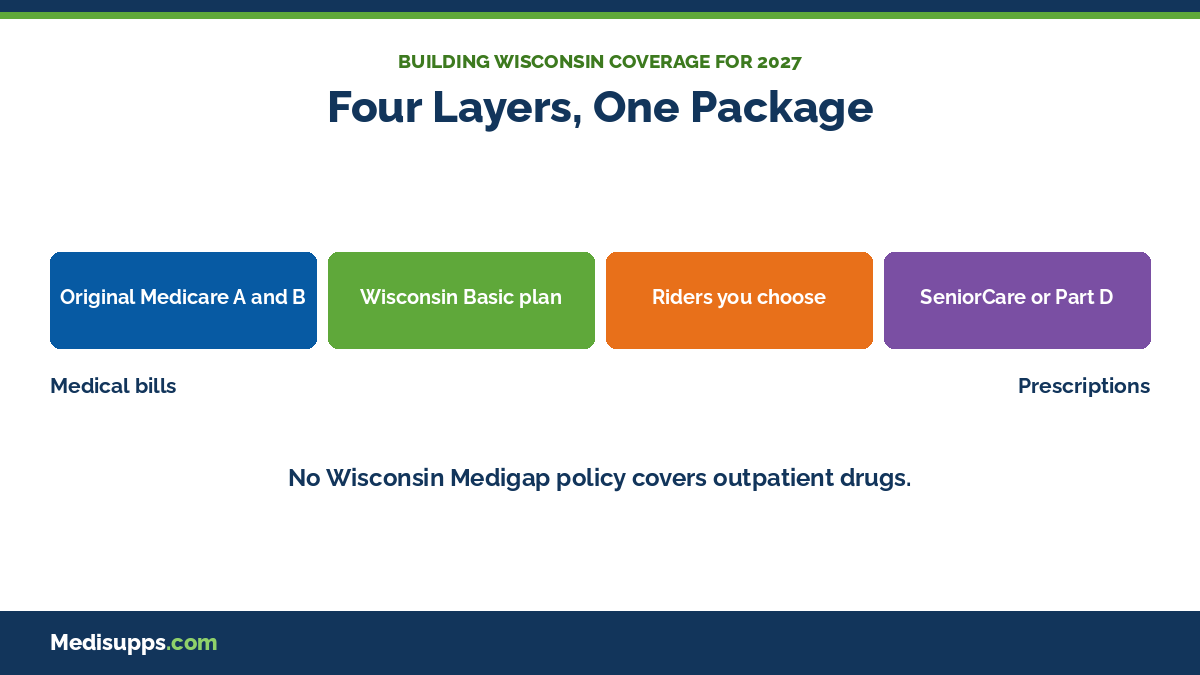
Medicare Supplement plans in Wisconsin for 2027 are built on the state’s own Basic plan plus optional riders instead of the federal Plan G and Plan N letters, and like every Medigap policy they do not pay for prescriptions. Wisconsin residents 65 and older have an unusual way to fill that gap: SeniorCare, a state drug program that costs $30 a year to join and counts as creditable coverage, so you can use it instead of, or alongside, a Medicare Part D plan.
Wisconsin 2027 rates
Price a Wisconsin Basic Plan and the Riders You Need
Compare Medigap premiums from several Wisconsin insurers by ZIP code.
Rates and plan availability vary by state, age and insurance company.
This page covers that pairing decision: what a Wisconsin Medigap policy leaves for your drugs, how SeniorCare’s income levels and deductibles work, what each level costs before copays, and how it compares with a Part D plan whose 2027 deductible can be as high as $700. For the full rider-by-rider breakdown and the companies selling the Basic plan, see our main Wisconsin Medicare Supplement guide, and for the national plan letters see Medicare Supplement plans for 2027.
Bottom line first
In Wisconsin for 2027 you buy the state Basic Medigap plan, add riders such as the Part A deductible rider to approach Plan G-level coverage, and then cover prescriptions separately with a Part D plan, the state’s SeniorCare program, or both, since SeniorCare is creditable coverage and costs $30 a year to join.
A Wisconsin Medigap Policy in Four Pieces
Wisconsin kept its own Medigap rules when Congress standardized the plans in 1990, so shopping here works more like ordering from a menu than choosing a letter.
Every policy comes with a 30-day free look, and Wisconsin’s Medigap open enrollment period starts the month you enroll in Part B, whatever your age. Milwaukee-area readers can compare local options in our guide to the best Medicare Supplement plans in Milwaukee.
The Gap Every Wisconsin Supplement Leaves: Prescriptions
A Basic plan with the Part A deductible and excess charge riders handles nearly all Medicare-covered medical bills, leaving roughly the $292 Part B deductible for 2027. Pills from the pharmacy are a separate matter, and going without drug coverage has a lasting cost.
The 63-day rule
If you go 63 days or more without creditable drug coverage after your Part D enrollment period, Medicare adds a late enrollment penalty of at least 1% of a base premium for each month without coverage, for as long as you have Part D. SeniorCare counts as creditable coverage, which is why it can stand in for Part D.
SeniorCare: Wisconsin’s Own Drug Program
SeniorCare is run by the Wisconsin Department of Health Services for residents 65 and older who are not enrolled in full-benefit Medicaid such as BadgerCare Plus. More than 91,000 people used it each month as of 2025. You can apply starting the month you turn 65, coverage begins the month after you apply, and you renew every year.
| SeniorCare level (2026) | Yearly income, individual | Yearly income, couple | What you pay before copays |
|---|---|---|---|
| Level 1 (up to 160% of poverty) | $25,536 or less | $34,624 or less | No deductible |
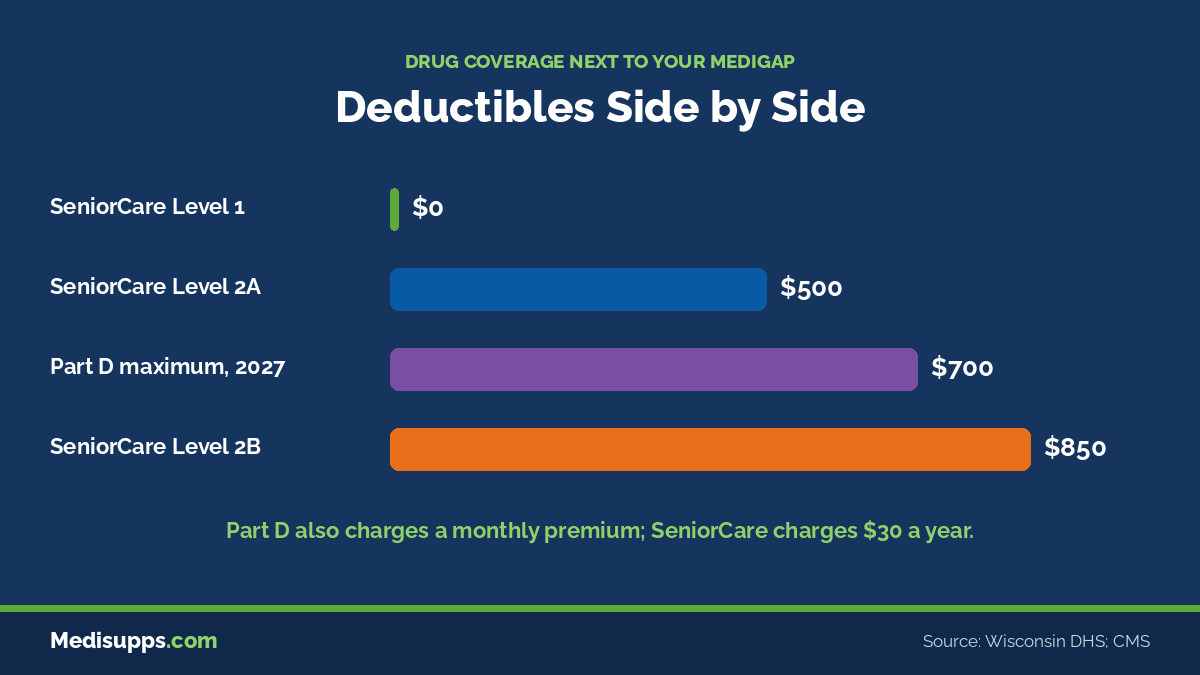
| Level 2A (160% to 200%) | $25,537 to $31,920 | $34,625 to $43,280 | $500 deductible |
| Level 2B (200% to 240%) | $31,921 to $38,304 | $43,281 to $51,936 | $850 deductible |
| Level 3 (above 240%) | $38,305 or more | $51,937 or more | A spenddown equal to income above 240% of poverty, then the $850 deductible |
Source: Wisconsin Department of Health Services, SeniorCare annual income limits (revised February 3, 2026) and publication P-10078 (02/2026). Limits are updated each year.
Once the deductible is met, SeniorCare copays are $5 for each covered generic drug, $15 for each covered brand-name drug and $0 for vaccines.
Wisconsin Medigap Quotes
Call a Licensed Agent Now
A licensed agent can price the Wisconsin Basic plan with the riders you want.
No obligation to enroll
Our Math: What SeniorCare Costs Before and After the Deductible
To put the levels in dollars, we priced one example year for a single person filling two generic prescriptions and one brand-name prescription every month, 36 fills in all, assuming the deductible is met early in the year.
| Level | Enrollment fee | Deductible | Copays on 36 fills | Example yearly total |
|---|---|---|---|---|
| Level 1 | $30 | $0 | $300 | $330 |
| Level 2A | $30 | $500 | Up to $300 | Up to $830 |
| Level 2B | $30 | $850 | Up to $300 | Up to $1,180 |
Our calculation: 24 generic fills at $5 and 12 brand fills at $15 equal $300. Fills used to meet the deductible do not also carry a copay, so totals at Levels 2A and 2B are upper estimates. Level 3 adds a spenddown that depends on income. Example only.
How Part D compares
A Part D plan’s 2027 deductible can be up to $700, plus a monthly premium that varies by plan and county. For a Level 1 SeniorCare member, $330 a year is hard for most Part D plans to match; at Levels 2B and 3, Part D, or Part D alongside SeniorCare, often deserves a price check.
Drug coverage check
SeniorCare must be renewed every year. A lapse without Part D in place starts the 63-day clock toward a permanent Part D late enrollment penalty, so the renewal date belongs on the same calendar as the Medigap premium due date.
Russell Noga, Licensed Insurance Agent
SeniorCare, Part D or Both With Your Supplement
Wisconsin’s health department notes that you can hold SeniorCare and a Part D plan at the same time, with SeniorCare coordinating with your other coverage. Before you drop either one, confirm the other is in force, because letting SeniorCare lapse without Part D can bring the late penalty later.
Your 2027 Wisconsin Enrollment Calendar
The state’s largest Medigap carrier is profiled in our WPS Medicare Supplement review. You can also browse every Medicare Supplement plans guide, compare Medicare Supplement plans by company, or start at the Medisupps.com home page.
Medigap plus drug coverage
Build Your Full Wisconsin Coverage Package for 2027
Line up a supplement and the right drug coverage before you enroll.
Rates and plan availability vary by state, age and insurance company.
Wisconsin Medigap and SeniorCare: Common Questions
➤ Does SeniorCare count as creditable coverage so I avoid the Part D penalty?
Yes. The Wisconsin Department of Health Services says SeniorCare is creditable coverage, meaning it is considered as good as standard Part D. Keeping it in force protects you from the late enrollment penalty.
➤ Can I have SeniorCare and a Wisconsin Medigap policy at the same time?
Yes. SeniorCare is open to Wisconsin residents 65 and older regardless of other coverage, except full-benefit Medicaid. A Medigap policy pays medical bills and SeniorCare covers prescriptions, so the two work side by side.
➤ What does SeniorCare cost a single person at Level 1 in 2026?
Level 1 covers individuals with yearly income of $25,536 or less. There is no deductible, just the $30 yearly enrollment fee and copays of $5 per generic and $15 per brand-name drug.
➤ Do any Wisconsin Medigap riders cover prescriptions?
No. Wisconsin’s optional riders add things like the Part A deductible, Part B excess charges and foreign travel coverage, but none adds outpatient drug coverage.
➤ Can I keep SeniorCare and also join a Part D plan?
Yes. You can enroll in both at the same time, and SeniorCare coordinates with Part D. Some people use both when their drug costs are high.
➤ When can a Wisconsin resident first apply for SeniorCare?
Starting the month you turn 65, and at any time after that. Coverage begins the month after you apply, and you must renew each year.
Free Wisconsin Review
Call a Licensed Agent Now
Compare 2027 Medigap premiums from several Wisconsin insurers in one call.
No obligation to enroll
Medisupps.com is operated by ZRN Health & Financial Services, LLC, a licensed insurance agency based in Austin, Texas. We are not connected with or endorsed by the U.S. government or the federal Medicare program. Premiums are examples only; your rate depends on your age, ZIP code, tobacco use and the insurance company.
Russell Noga is the CEO and Medicare editor of Medisupps.com. His 18+ years of experience in the Medicare insurance market includes being a licensed Medicare insurance broker in all 50 states. He is frequently featured as a featured as a keynote Medicare event speaker, has authored hundreds of Medicare content pages, and hosts the very popular Medisupps.com Medicare Youtube channel. His expertise includes Medicare, Medigap insurance, Medicare Advantage plans, and Medicare Part D.