
 Reviewed by: Russell Noga, Licensed Insurance Agent · Updated November 23, 2026
Medicare Supplement plans in Washington State are sold by about 20 insurers on the state’s approved list, but which ones you can buy depends on your county, and for 2027 Washington residents also have a state-sponsored Plan G through the Health Care Authority priced at $273.96 a month. Every policy is community rated, so the price does not change with your age.
Washington rates by county
See Which Medigap Companies Serve Your Washington County
Compare community-rated Plan G, Plan N and high-deductible G prices in one place.
Rates and plan availability vary by state, age and insurance company.
Many guides stop at the plan letters. This one looks at the parts of the Washington market that shape your real choices: which carriers sell only in certain counties, how much the largest regional carrier raised its prices in 2026, the little-known state group plan open to any eligible resident, the less common letters such as K and L, and the state law that limits how long a policy can make you wait for coverage. For every letter side by side, start with our guide to Medicare Supplement plans for 2027.
Benefits for each letter are fixed by federal law, so a Plan G from one Washington company pays the same claims as a Plan G from another. Price, service area and rate history are what differ.
Washington at a glance
For 2027, Washington buyers choose from roughly 20 Medigap insurers, some limited to certain counties, plus a state Health Care Authority Plan G at $273.96 a month for residents. Prices are the same at every age, but Premera raised its 2026 rates by about 15% to 20% depending on the plan.
Who Sells Medigap in Washington, and Where
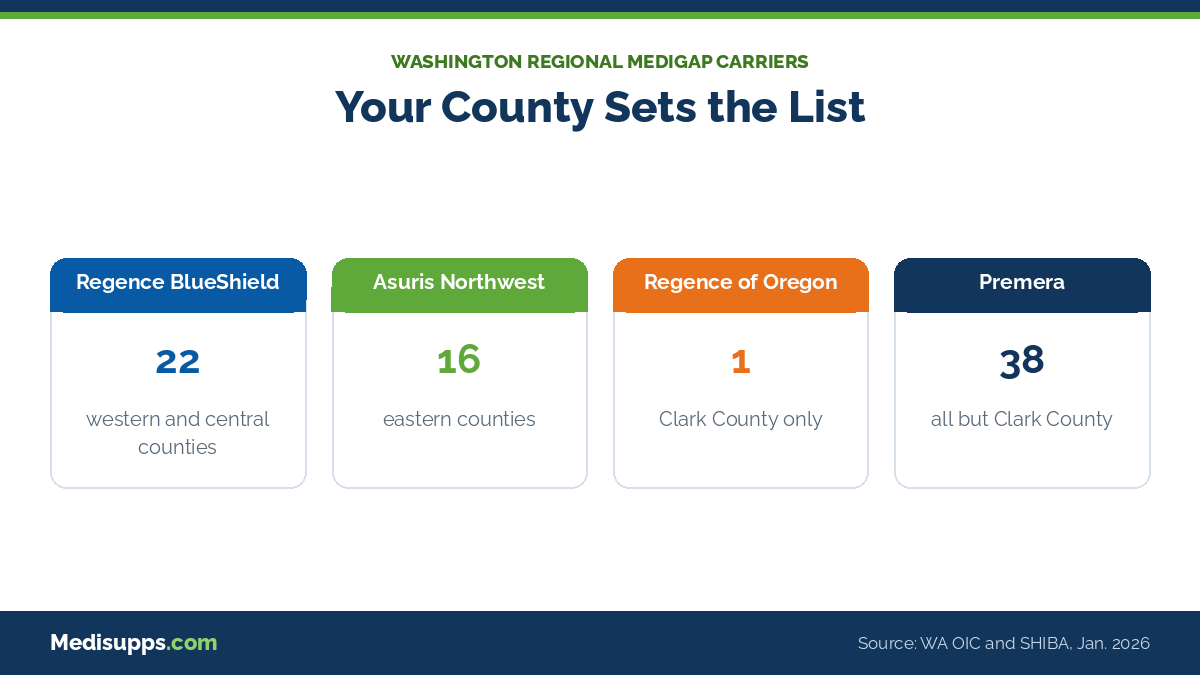
The Office of the Insurance Commissioner and its SHIBA counseling program publish a list of approved Medicare Supplement plans, updated through the year; the latest edition is dated October 8, 2026. The edition with rates current as of January 7, 2026 shows 20 entries, from national names such as Mutual of Omaha’s United World Life, Transamerica and USAA to regional Blue plans. Most sell statewide. Four do not.
| Insurer | Where it sells | Counties covered |
|---|---|---|
| Regence BlueShield | Western and central Washington, including King, Pierce, Snohomish, Thurston, Whatcom and Yakima | 22 counties |
| Asuris Northwest Health | Eastern Washington, including Spokane, Benton, Franklin, Chelan and Whitman | 16 counties |
| Regence BlueCross BlueShield of Oregon | Clark County only | 1 county |
| Premera Blue Cross | Every county except Clark | 38 counties |
Source: Washington OIC and SHIBA approved Medigap plans list, rates current as of 1/7/2026. Washington has 39 counties. Service areas can change, so confirm on a current quote.
The practical result is that a retiree in Vancouver sees a different set of Blue plans than one in Spokane or Seattle. The list also includes First Health Life & Health Insurance Company, which AM Best lists as part of the Aetna Health and Life group, so an Aetna-family policy can appear on a Washington quote under that name rather than the Aetna brand.
Premera’s 2026 Price Change, Plan by Plan
Community rating means everyone on the same plan pays the same price, so the only way a Washington premium goes up is a company-wide rate change approved by the insurance commissioner. Premera’s producer bulletins publish its approved rates each February, which makes it one of the few carriers whose year-over-year change can be checked plan by plan.
| Premera plan | April 2025 rate | April 2026 rate | Change |
|---|---|---|---|
| Plan A | $205 | $245 | +19.5% |
| Plan C (eligible before 2020) | $278 | $333 | +19.8% |
| Plan G | $243 | $291 | +19.8% |
| High-deductible Plan G | $64 | $76 | +18.8% |
| Plan N | $192 | $220 | +14.6% |
Source: Premera producer news, approved Washington Medicare Supplement rates effective April 1, 2025 and April 1, 2026, monthly, without the spousal discount. Percent changes are our math.
What the numbers show
Plan N rose about 5 points less than Plan G. On Premera’s 2026 rates, the yearly gap between the two grew to $852, from $612 the year before.
Two ways to pay less
Premera’s 2026 spousal rate for Plan G is $262, about 10% below the single rate, and members who pay by automatic funds transfer save another $5 a month. Washington law allows only spousal, payment-frequency and payment-method discounts, so these are the only price breaks a carrier can offer.
The State’s Own Plan G for Washington Residents
Few shoppers know that the Washington State Health Care Authority sponsors a group Medicare Supplement Plan G, insured by Premera Blue Cross. Public employees’ retirees get it through PEBB, but the approved list notes that it is also sold to Washington residents who are not PEBB members, at a separate state resident rate.
- ✔Up to 30 days before Medicare Parts A and B begin, or within six months of turning 65 while enrolled in Part B.
- ✔Within 63 days of becoming a Washington resident.
- ✔Within 63 days of losing qualifying coverage, such as a retiree group plan, a Medicare Advantage plan or another Medigap policy.
- ✔You must have Parts A and B and not receive Medicaid help other than payment of your Part B premium.
At $273.96, the state plan is not the cheapest Plan G on the market, but it is open to people on Medicare because of a disability at a published rate, and its 63-day window after moving to Washington is a useful option for new arrivals.
Washington Medigap Quotes
Call a Licensed Agent Now
Licensed agents compare approved Washington Medigap carriers for your county at no cost.
No obligation to enroll
Beyond G and N: Plans A, K, L and High-Deductible G
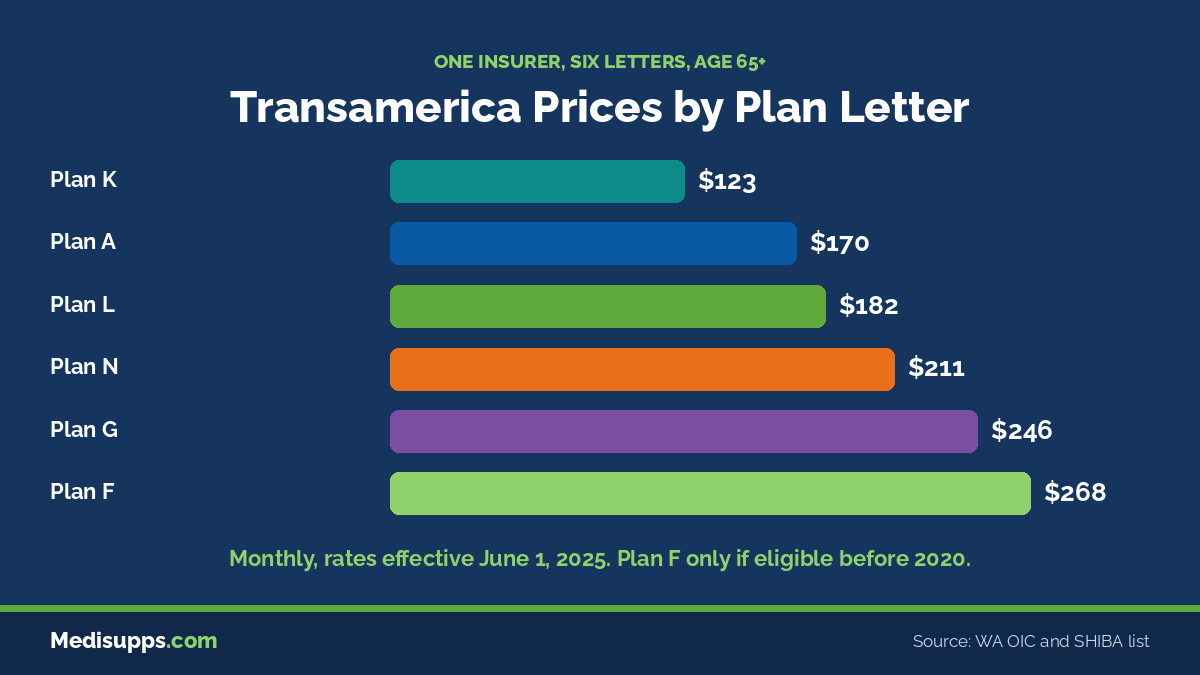
Washington insurers can sell all ten standardized letters, but most file only a few. Transamerica is one of the exceptions: its row on the state list prices every letter, which gives a rare view of how the letters compare inside a single company.
Plan A is the only letter every insurer must offer, and in Washington it carries a switching limit: owners of Plan A can move without health questions only to another company’s Plan A, while owners of Plans B through N can move among those letters. Our Medicare Plan G Washington guide covers the most popular letter in detail.
Washington’s Limits on Waiting Periods and Denials
Chapter 48.66 of the Revised Code of Washington adds protections that go further than federal rules in a few places that matter when you apply.
Under 65 in Washington
Washington does not require insurers to sell Medigap to people under 65, and companies that do may use a separate disability pool. The state Plan G’s $465.73 disability rate, about 70% above its age-based rate, shows how large that gap can be.
Before you switch
Washington caps pre-existing condition waiting periods at three months and requires a replacing insurer to credit time already served on a policy in force for at least three months. Keeping the current policy until the new one is issued and the 30-day free look has passed avoids any gap in coverage.
Russell Noga, Licensed Insurance Agent
Planning a Washington Medigap Purchase for 2027
- ✔Start with your county. Ask which Blue plan serves it before comparing prices.
- ✔Ask each carrier for its last two rate changes. Community rating removes age increases, so company-wide changes are the whole story.
- ✔Price the spousal and automatic-payment discounts; they are the only ones Washington allows.
- ✔Budget the 2027 Part B deductible of $292 on Plan G or N, or up to $3,050 on high-deductible G.
- ✔Add a separate Part D plan, since no Medigap policy covers prescriptions.
If you already own a policy, our Washington Medigap rates and switching guide walks through moving between companies. You can also browse all Medicare Supplement plans or start a new comparison from the Medisupps.com home page.
Free price check
Is Your Washington Medigap Premium Still Competitive?
Line up your renewal against other approved Washington insurers before you decide to stay or move.
Rates and plan availability vary by state, age and insurance company.
Medicare Supplement Plans in Washington State: Your Questions
➤ What is the Washington State Health Care Authority Medigap plan?
It is a group Medicare Supplement Plan G insured by Premera Blue Cross and sponsored by the Health Care Authority. Washington residents who are not PEBB members can buy it at the state resident rate, which is $273.96 a month from January 1, 2027 for people eligible by age.
➤ How much did Premera raise its Washington Medigap rates in 2026?
Premera’s approved rates effective April 1, 2026 rose about 19.8% for Plan G, to $291 a month, and 14.6% for Plan N, to $220. Plan A, Plan C and high-deductible G rose about 19% to 20%.
➤ Which Medigap companies sell only in part of Washington?
On the state’s January 2026 list, Regence BlueShield sells in 22 western and central counties, Asuris Northwest Health in 16 eastern counties, Regence BlueCross BlueShield of Oregon only in Clark County, and Premera everywhere except Clark County.
➤ How long can a Washington Medigap policy exclude a pre-existing condition?
No more than three months. State law also bars a look-back of more than three months, and a replacing insurer must credit time already served under a policy that was in force for at least three months.
➤ Can I buy Plan K or Plan L in Washington?
Yes, from companies that file them, such as Transamerica, whose state list prices were $123 for Plan K and $182 for Plan L. For 2027 their out-of-pocket limits are $8,360 and $4,180.
➤ What happens if a Washington insurer turns down my application?
The insurer must tell you in writing and include information about Medicare Advantage options and the Washington State Health Insurance Pool. You may still have guaranteed rights elsewhere, such as the state Plan G within 63 days of losing qualifying coverage.
Compare Washington Plans
Call a Licensed Agent Now
See community-rated Medigap prices from several Washington insurers in one call.
No obligation to enroll
Medisupps.com is operated by ZRN Health & Financial Services, LLC, a licensed insurance agency based in Austin, Texas. We are not connected with or endorsed by the U.S. government or the federal Medicare program. Premiums are examples only; your rate depends on your age, ZIP code, tobacco use and the insurance company.
Russell Noga is the CEO and Medicare editor of Medisupps.com. His 18+ years of experience in the Medicare insurance market includes being a licensed Medicare insurance broker in all 50 states. He is frequently featured as a featured as a keynote Medicare event speaker, has authored hundreds of Medicare content pages, and hosts the very popular Medisupps.com Medicare Youtube channel. His expertise includes Medicare, Medigap insurance, Medicare Advantage plans, and Medicare Part D.